Kindergarten Activity No. 55 : Bingo

Bingo Games

Bingo shapes and numbers games are a great way for children to:

  • learn about shapes
  • reinforce their number recognition skills
  • develop their counting skills
  • enhance their matching skills.


These games will also help children reinforce their:

  • visual perception
  • concentration
  • critical thinking ability (which enhances cognitive development).

Bingo Games: Shape Bingo and Number Bingo


For these bingo games you need:

  • A print-out of the bingo sheets. (Click on the below link for the sheets) If you laminate them they will last longer

 bingo

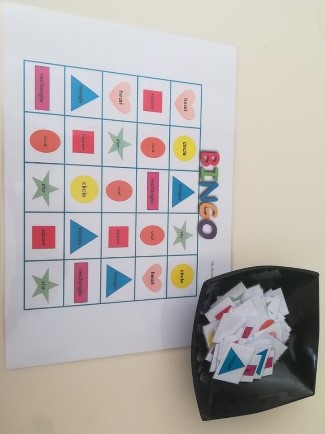
  • A print-out of the call sheets. (After printing the call sheets cut them into shape and number cards and put them into a bowl, as indicated in the picture).

Game 1: Bingo Number Game
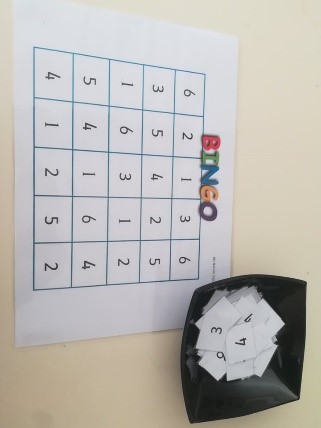
How to play this game:

  1. Draw a number card from the bowl.
  2. Give your child the card. S/he must say the number on the card and place it on a matching number on the bingo board.


As soon as your child covers all the squares on the bingo board s/he should shout: “BINGO !!!”

Game 2: Bingo Shape Game


How to play the game:

This game is played as the Bingo Number Game.

  1. Draw a shape card from the bowl.
  2. Give your child the card. S/he must say the name of the shape on the card and then place it on a matching shape on the bingo board.


As soon as your child covers all the squares on the bingo board s/he shouts: “BINGO !!!”

Game 2: Bingo Shape Game
Here is a you tube video showing an adult playing shape bingo with a group of children:

https://www.youtube.com/watch?reload=9&v=5DesuChSZe0&feature=youtu.be&fbclid=IwAR2PdL9ZR3DbAJ0J2Rjn9BVosact5UVsEFWfGp3QUnSKRcYPn1nnY7HPRwY


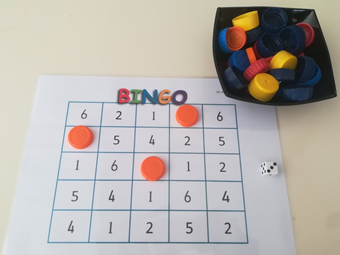
Variation:  To make Bingo Number Game more challenging you can use dice.
How to play the game:

  1. Ask your child to roll the dice and count the number of the dots on the face of the dice and say the number, for example 3.
  2. Your child has to cover all the squares on the board that have the number 3 on them. (As indicated in the picture).


As soon as your child covers all the squares on the bingo board s/he shouts: “BINGO !!!”


These bingo games can be played in small groups, in pairs or individually.


Ms.Natalie Agius K 1.6
 

Kindergarten Activity No. 54 : Symmetry

The following activities will help children to be able to identify objects/shapes that are symmetrical and to copy patterns to achieve symmetry.

What is symmetry?

An object that has symmetry can be divided into identical pieces.  An object that has reflectional symmetry is like a mirror image. At this stage it is not important that the children know the word reflectional symmetry. They must understand the concept of symmetry. One example of mirror image symmetry is a butterfly. When a butterfly folds its wings, it is easy to see that the wings are the same on both sides.


Activity 1:

For this activity you need:  a piece of paper, some paint, and a brush.

This simple artwork will help children understand symmetry easily.

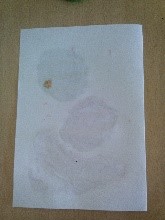
  • Fold a piece of paper in half.


  • Give your child some paint and a brush.


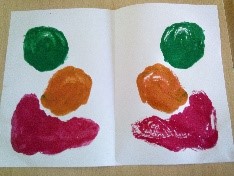
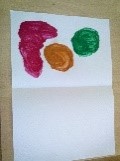
  • Ask him/her to paint something s/he likes on one side of the paper only. (As indicated in the picture)

  • Before the paint dries, fold the paper in half and press.

  • Open the paper to reveal the print. Point out to your child that what s/he painted on one side of the fold is now visible on the other side of the fold.

You can follow this video https://www.youtube.com/watch?v=042uDqg2k3g to complete the above activity.


Activity 2:

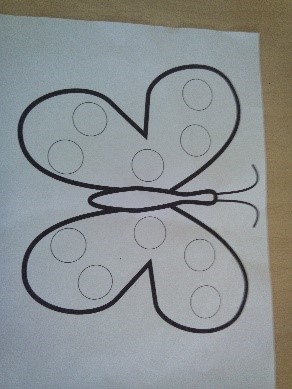
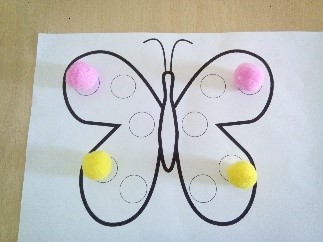
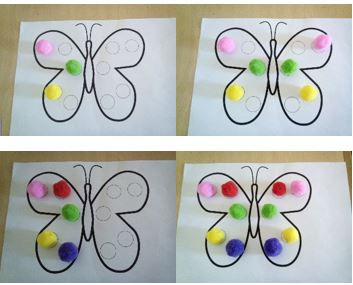
For this activity you need:  a print-out of the butterfly and some coloured pompoms of the same size.

Explain to your child that to achieve symmetry s/he needs to copy the pattern exactly as it is.

  • Print the butterfly to show your child how symmetry can be achieved. click here for printout: butterfly print-out

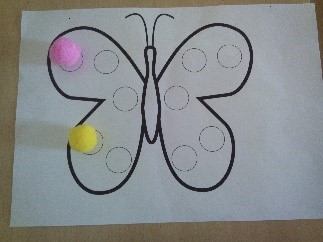
  • Take the pompoms. Make sure you have 2 pompoms of each colour.


  • Place one or two pompoms on one side of the butterfly. Ask your child to copy the pattern on the other side. (As indicated in the pictures).

  • Increase the number of pompoms gradually.

Following is an online game. In this game your child must complete a picture by finding the other symmetrical half.

https://www.topmarks.co.uk/symmetry/symmetry-matching


Ms Maria

K1.5

Kindergarten Activity No. 53: Planting a Flower Seed

Planting a Flower Seed

Planting is a children’s favourite gardening and science activity. Children like to observe the plants’ growth and at this time of year this would be a great activity to carry out with your children at home.

Children fascinate themselves watching the first green shoot coming out of the soil. They enjoy taking care of their plant by watering it.

During this activity you can use different seeds so that children can compare their sizes and appearances.

Children can benefit and acquire different skills from this gardening activity such as:

  • develop patience while waiting for the seed to grow into a flower,
  • learn about how to be responsible while taking care of the plant,
  • learn about the life cycle of a flower,
  • develop fine motor skills,
  • spend quality time and create a bond with the parent.


Click here for a child friendly video explaining how plants grow.

Before starting the activity, watch this online story.

We plant seeds – Click here

For this activity you will need:

  • soil
  • pots
  • seeds
  • water spray bottle
  • water
  • scoop

Steps how to plant a seed:

  1. Give your child some soil, and ask him/her to fill the pot, leaving about 2cm, to the top. Encourage him/her to count out loud each time s/he scoops the soil.
  2. Place some seeds on the palm of your child’s hand. Encourage him/her to count how many seeds s/he has before planting them.
  3. Once the seeds are planted ask your child to place a little more soil on top of the seeds and to press lightly.
  4. Explain that the seeds need water to grow. Give your child a spray bottle so they can mist the soil.
  5. Ask your child to find a place in the house where to put the planted seed. The place must have enough light for the plant to grow.  This could be a windowsill, a yard, or a balcony.


Below you can  find a worksheet the children can do about the life cycle of a flower.

worksheet life cycle of a flower


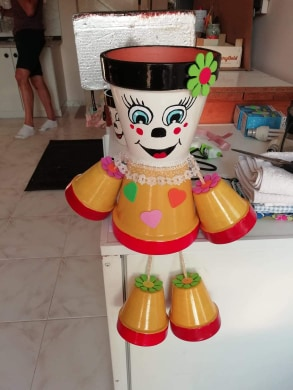
You can also take this activity a step further and create a cute clay pot doll for your plant. This would be an ideal gift for Mother’s Day. Children can paint and decorate the clay pot however they like with any materials they want such as paint, glitters, markers, buttons, beads, cloth, felt, etc… This needs to be done before planting the seeds, so that it will dry completely.

Click here to watch these YouTube videos showing you how to make cute clay pot dolls.

Clay pot people

DIY Clay pot people


I would like to take this opportunity to wish you all the love, health, and happiness that you deserve. Happy Mother’s Day!


Ms. Maria

K2.2