
Home

Kindergarten Activity No. 41 : Counting

Counting Activity with Playing cards

Peg the Number – game

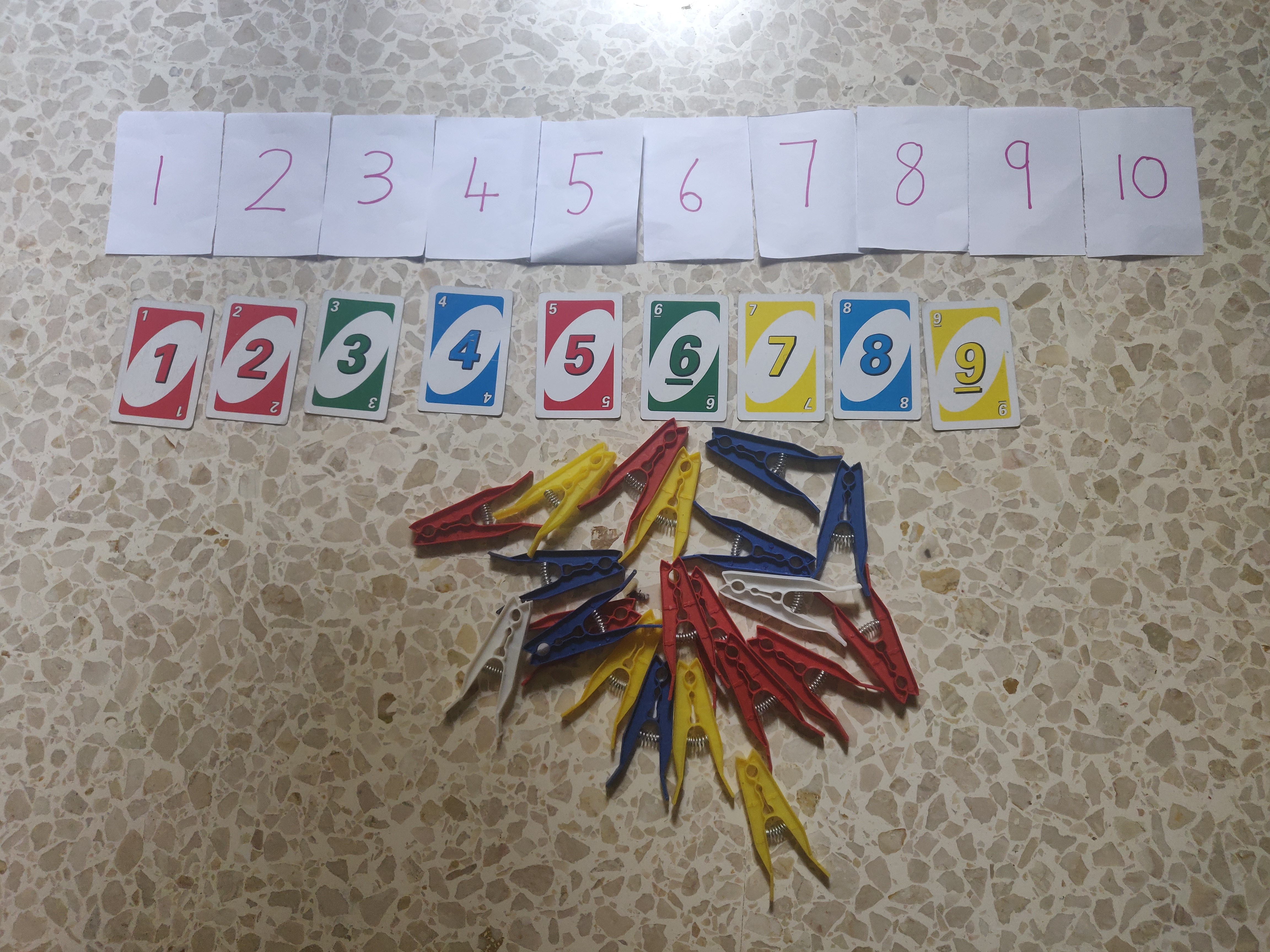
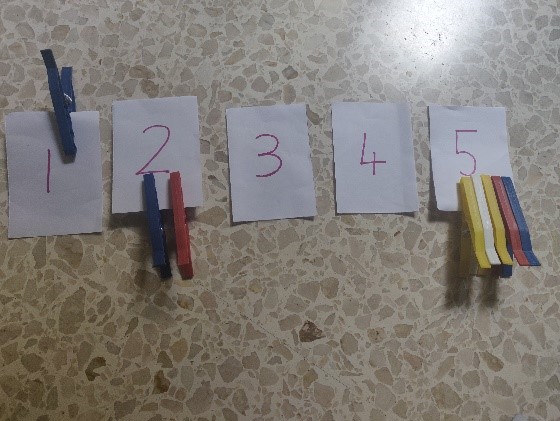
At this age it is important that children learn to count and learn the value of numbers. This will prepare them for more difficult mathematical tasks. This activity involves clipping a number of pegs to a number card. For example, clipping 2 pegs to the card with the number 2 on it.

This is a great game for:

  • practicing and reinforcing number recognition and value
  • enhancing their language development (by naming numbers)
  • developing their fine motor skills, hand-eye coordination and concentration.

For this game you will need:

  • Pegs
  • Playing Cards (like UNO) if you do not have playing cards you can do your own. (As seen in the picture)
Aim:

  • Number recognition
  • Number Value
  • Counting from 1 to 10 (You can choose to focus on the numbers from 1 to 5 or from 1 to 10, depending on the ability of your child).
  • Hand and eye cordination
  • Pincer grip improvment


  • Start this activity by watching this video. Encourage your child to sing along the number song. https://www.youtube.com/watch?v=85M1yxIcHpw
  • After watching the video, lift a card up (e.g. 5) and ask your child to say the number on the card out loud.
  • Focus on the number and make sure your child recognises it.
  • Ask your child to count out 5 pegs.  Touching the pegs will help him/her grasp the concept better. Encourage him/her to count out loud while picking the pegs.
  • Once your child has picked the correct number of pegs, ask him/her to clip them to the car.
Ms. Abigail

K 1.10


Ċirkolari Importanti : Ġbir ta’ Kotba u Pitazzi mill-Iskola

Għeżież Ġenituri
Fil-ġimgħat li ġejjin se tingħataw l-opportunita’ li tiġu l-iskola u tiġbru l-kotba u pitazzi tat-tfal. Ser inkunu qed nagħtukom data u ħin meta tistgħu tagħmlu dan.  Importanti li tiġu dakinhar biex tkunu tistgħu tieħdu l-affarijiet tat-tfal. Nitolbukom li żżommu mal-ħin biex ma jkunx hemm dewmien.
Aqra ċ-ċirkolari li ntbagħtet mid-dipartiment hawn: Note to Parents Collection of Books MLT
Grazzi
N Saliba
Dear Parents
In the coming weeks you will be given the opportunity to come to school to collect your children’s books and copybooks.  We will be sending you a date and time when you can do this.  It is important that you come on the specific date and time to collect your children’s things.
Read the circular sent by the department here: Note to Parents Collection of Books ENG
Regards
N Saliba

Kindergarten Activity No. 40 – A Science Experiment

Blubber Experiment

Before starting this experiment make a brainstorm activity with your child about the Arctic. Which animals live in the Arctic? How do animals manage to survive there? What keeps them warm?

photo credits: http://www.pexels.com

What is Blubber?

Many of our favourite animals live in the Arctic Ocean.  Temperatures in the Arctic are very cold.  But polar bears, whales, seals and penguins survive in this weather.  They manage to do so because they have blubber under their skin.  Blubber is sea animal fat. Animals like polar bears, apart from having a thick fur to keep them warm, they have a layer of fat under their skin which is called blubber. This blubber experiment will help children understand why these animals manage to live in such cold temperatures.


For this experiment you will need:(Before starting the experiment explain to your child that in this experiment the plastic bag will be the animal’s skin while the butter will be the blubber).


  • 2 Large bowls (large enough for a hand to fit in)
  • Ice Cubes
  • Cooking fat or butter
  • 2 plastic bags (large enough for a hand to fit in)
  • Duct tape
  • Food Colouring (optional)


  1. Fill 2 bowls with ice water. (You may add food colouring to the water).
  2. Take the two plastic bags. Fill one of the plastic bags with butter or fat (leave the other one empty).
  3. Ask your child to put his hand in the empty plastic bag and then put that same hand in the plastic bag filled with butter/fat.
  4. Seal the tops with duct tape so water can’t get into the bags.
  5. Make sure to move the fat around so that it covers the hand completely.
  6. Leave the other hand bare.
  7. Put the bowls filled with ice on the table. Ask your child to place both hands in the bowls. (Tell your child to take out his/her hands if it feels too cold).

Ask your child:

  • What do you notice?
  • Which hand is colder? (the one covered in fat or the bare one?)
  • Does the hand covered in fat feel the same as the bare hand?
  • What do you think is happening?
  • Why do animals who live in the Arctic need blubber?


IMPORTANT: Ask questions to make children think and help them arrive to the answer by themselves, rather than explaining everything yourself.   

Here is a link to a YouTube video showing and explaining this experiment

https://www.youtube.com/watch?v=_DQGAcqhkGs