Kindergarten Activity No. 43 – Auditory Memory

Auditory Memory

What is auditory memory?

Auditory memory is an important skill for coping and succeeding in life. It involves the skill of being able to remember what you hear and recall it later. Auditory memory also plays an important part in the development of auditory perception. This is the process that allows the brain to interpret what is being heard.

Children with poor auditory skills find it difficult to follow what is going on in class, to follow instructions and have problems with reading and writing. For a child to be able to understand what s/he hears and to follow directions and instructions, auditory memory needs to be developed.

Auditory Memory Games

Here are some auditory memory activities to play with your child. During these activities, your child will be asked to follow a set of instructions and record them on a worksheet. You can make the activities more challenging by adding more than one instruction at a time, according to your child’s ability.

I have prepared some handouts for you. These include an instruction sheet and a worksheet. I have also included a sample sheet (an example) of what your child has to do.

You can use these handouts or else you can make your own. Try to involve your child by encouraging him/her to draw and colour the shapes or pictures him/herself. You can also find pictures from magazines.

How to play this game:

For this activity you need to print the  instruction sheets and worksheets you can find at the end of this post.

1. Keep the instruction sheet yourself and give the worksheet to your child.

2. Make sure that your child is listening attentively.

3. Read out the instructions on the instruction sheet to your child and make sure your child understands what s/he has to do.

auditory activity level 1 shapes

auditory activity level 2 pictures

auditory activity level 2 shapes

auditory activity level 3 map activity

Ms Maria
Kindergarten Activity No. 42

L-għan ta’ dawn l-attivitajiet huwa li t-tfal isaħħu s-smigħ b’mod orali u jagħrfu d-differenza bejn il-kliem. Se jgħinuhom ukoll biex isaħħu l-vokabularju, kif ukoll il-memorja

.

Dawn il-kliem huma l-istess jew differenti?

  1. Ibda din l-attività billi tiddiskuti mat-tfal xi jfissru dawn il-kliem: l-istess u differenti.
  2. Meta t-tfal ikunu qabdu l-kunċett u qed jifmhu dawn il-kliem, spjega lit-tfal li se tkun qed tgħidilhom żewġ kelmiet u jridu jagħrfu jekk humiex l-istess jew differenti.
  3. Waqt din l-attività insisti fuq l-importanza tas-smigħ. Għid lit-tfal: “Iftħu widnejkom biex tisimgħu sew.”
  4. Jekk ikun hemm il-bżonn, irrepeti dawn il-kliem aktar minn darba.
  5. Kif it-tfal jisimgħu ż-żewġ kelmiet, staqsiehom jekk il-kliem li għadhom kemm semgħu, humiex l-istess jew differenti.

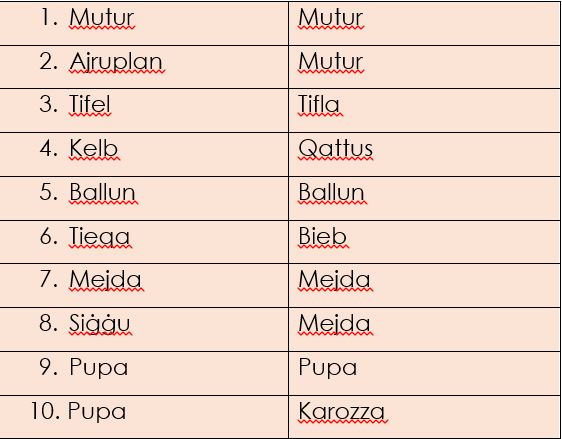
Eż.: Għid il-kliem : “mutur –    mutur”

     Staqsi: “L-istess?”

     It-tfal suppost iwieġbu: “Iva”

    Għid il-kliem : “mutur –    ajruplan”

     Staqsi: “L-istess?”

    It-tfal suppost iwieġbu: “Le”

Dawn huma eżempji ta’ kliem li jistgħu jintużaw.

Liema kelma hi differenti?

  1. Din id-darba, it-tfal se jisimgħu tliet kelmiet u jridu jagħrfu liema kelma hi differenti.
  2. Erġa’ insisti fuq l-importanza tas-smigħ waqt din l-attività.

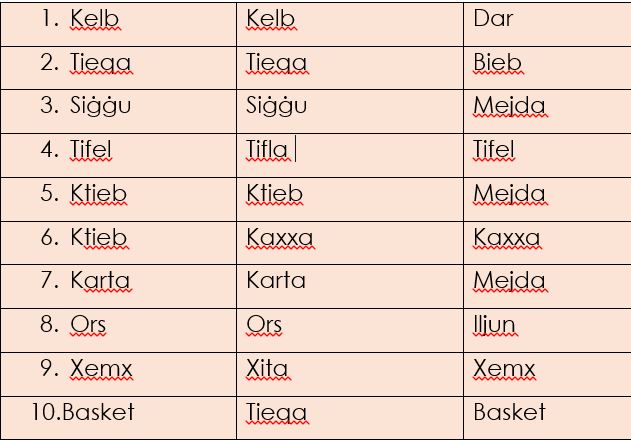
Eż. Għid il-kliem : “kelb – kelb – dar”

     Staqsi: “Liema kelma hi differenti?”

    It-tfal suppost iwieġbu: “dar”

   Għid il-kliem : “tieqa – tieqa – bieb”

   Staqsi: “Liema kelma hi differenti?”

   It-tfal suppost iwieġbu: “bieb”


Dawn huma xi kliem li jistgħu jintużaw.

Ms Rodianne

K2.1

Kindergarten Activity No. 41 : Counting

Counting Activity with Playing cards

Peg the Number – game

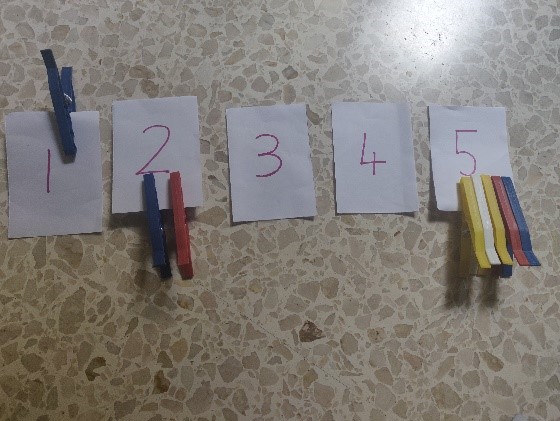
At this age it is important that children learn to count and learn the value of numbers. This will prepare them for more difficult mathematical tasks. This activity involves clipping a number of pegs to a number card. For example, clipping 2 pegs to the card with the number 2 on it.

This is a great game for:

  • practicing and reinforcing number recognition and value
  • enhancing their language development (by naming numbers)
  • developing their fine motor skills, hand-eye coordination and concentration.

For this game you will need:

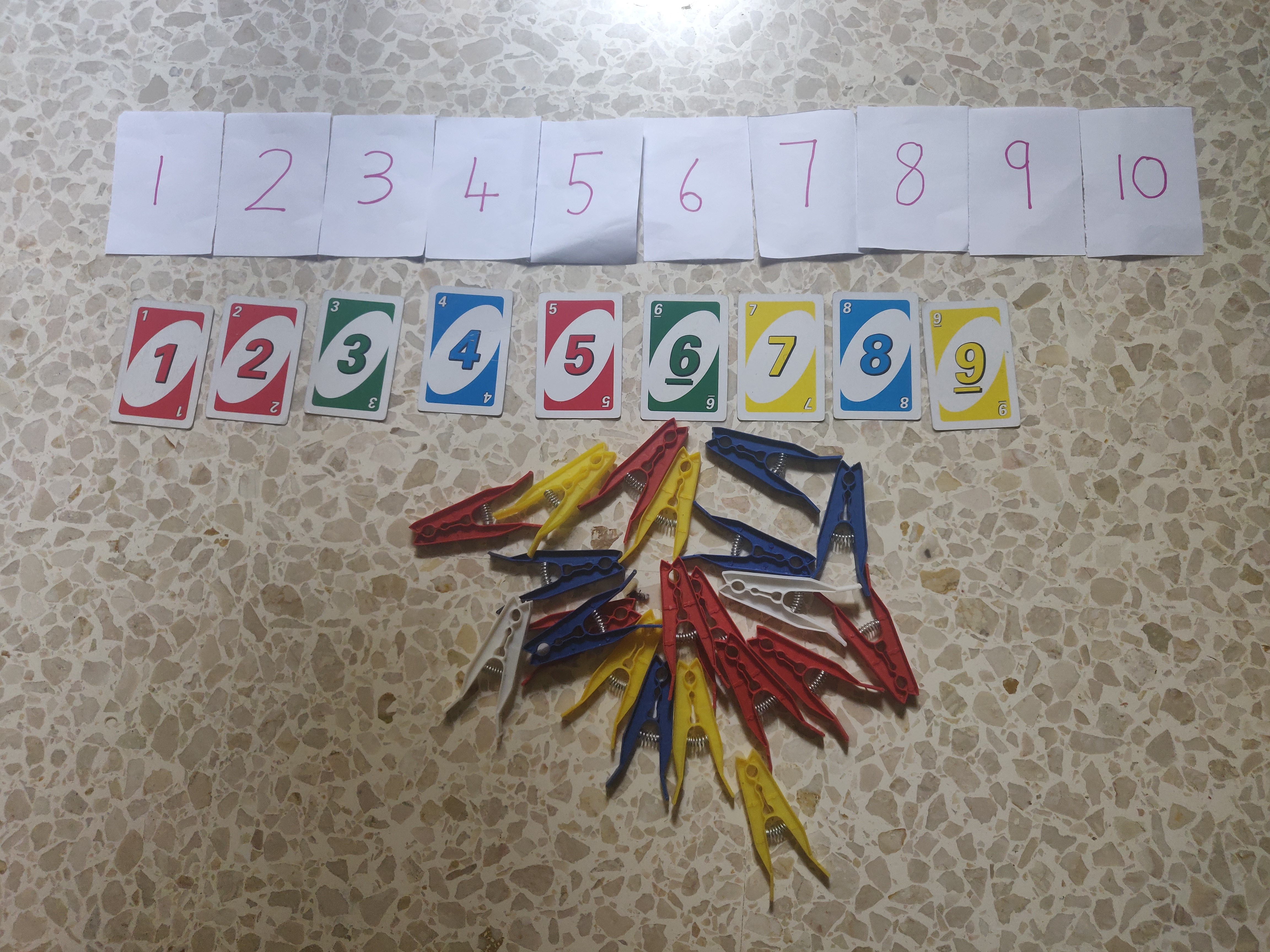
  • Pegs
  • Playing Cards (like UNO) if you do not have playing cards you can do your own. (As seen in the picture)

Aim:

  • Number recognition
  • Number Value
  • Counting from 1 to 10 (You can choose to focus on the numbers from 1 to 5 or from 1 to 10, depending on the ability of your child).
  • Hand and eye cordination
  • Pincer grip improvment


  • Start this activity by watching this video. Encourage your child to sing along the number song. https://www.youtube.com/watch?v=85M1yxIcHpw
  • After watching the video, lift a card up (e.g. 5) and ask your child to say the number on the card out loud.
  • Focus on the number and make sure your child recognises it.
  • Ask your child to count out 5 pegs.  Touching the pegs will help him/her grasp the concept better. Encourage him/her to count out loud while picking the pegs.
  • Once your child has picked the correct number of pegs, ask him/her to clip them to the car.

Ms. Abigail

K 1.10