Kindergarten Activity No 62 : Comparing Weight

Comparing objects by weight

From a young age, it is important that children are exposed to measurement concepts. Measurement concepts play a significant role in the development of the children’s problem-solving skills and help them make sense of the world around them.

It is crucial that children develop the basic concepts of measurement through play. Learning through play helps children learn faster and remember better what they have learnt. An easy and simple way to introduce this concept to your child is by asking him/her to compare weights by holding different objects in his/her hands.

The activities below aim at helping children practice and learn the concept of heavy and light by using concrete objects. The children will be asked to compare to objects based on their weight.


Activity 1:   Learning the difference between heavy and light.
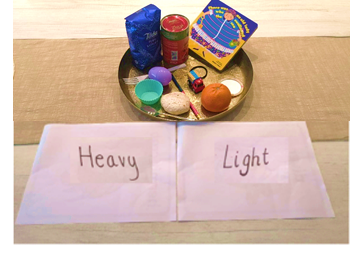

For this activity you will need:

  • 2 blank papers. Write heavy on one paper and light on the other paper. (As indicated in the picture)


  • Different items to weigh, for example: rock, pencil, cupcake case, spoon, plastic fork, toys, book, tin can.

Instructions:

  • Start this activity, by discussing with your child the terms “heavy” and “light”, using an example of each.

For example: use a bag of rice for “heavy” and a pencil for “light”.


  • Encourage your child to hold the bag of rice on the palm of one hand, and the pencil on the palm of the other. Ask your child if s/he feels the difference in weight.


  • Tell your child to do the same with the other items one by one. Make sure not to choose objects that are close in weight. 


  • Place the “heavy” items on the heavy paper, and the “light” items on the light paper.


  • Once the child places all the items on the appropriate paper, discuss and check whether s/he was correct.


Variations:

  • To make this activity more challenging, use a blindfold and tell the child to close his/her eyes when weighing the objects.
  • Encourage your child to find more heavy and light objects from around the house and compare their weight.


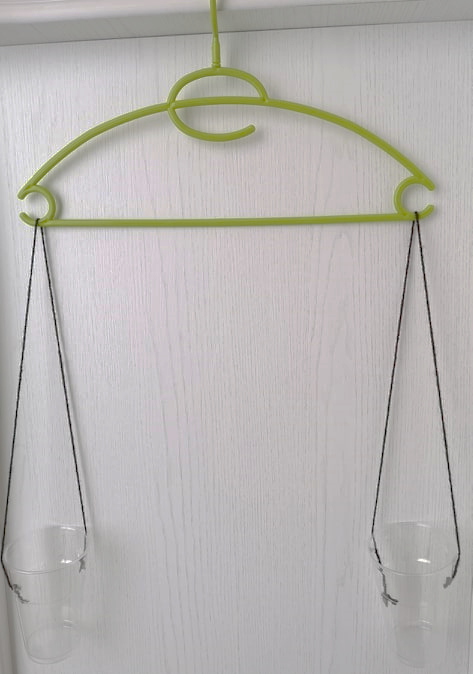
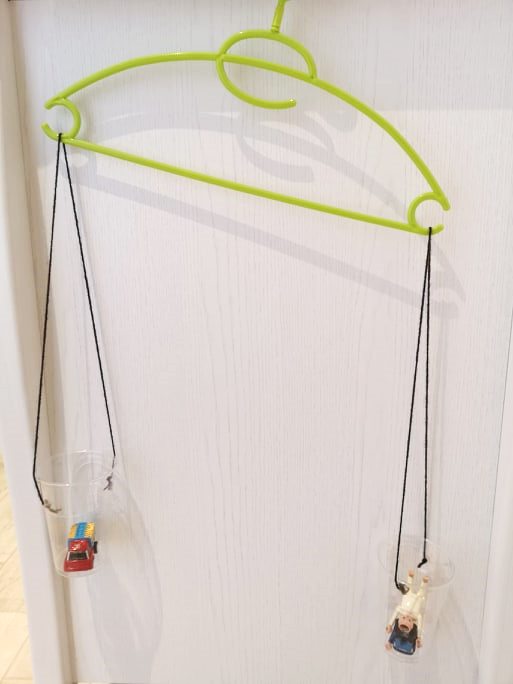
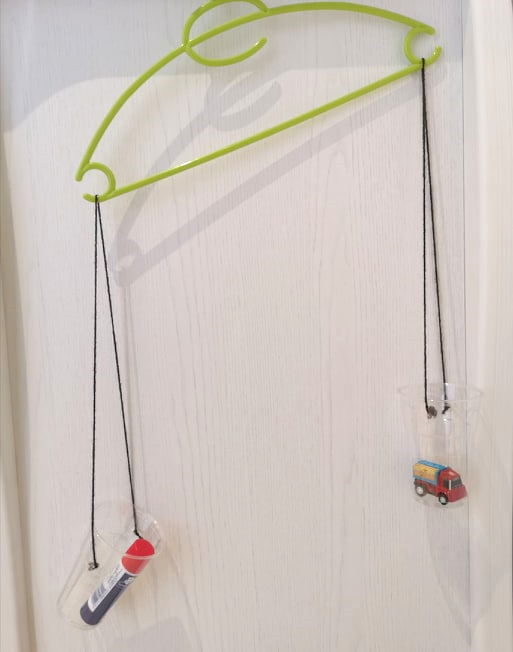
Activity 2:  Building a balance scale from a clothes hanger

For this activity you will need:

  • A plastic hanger
  • Two identical paper or plastic cups
  • 2 pieces of string/yarn (of equal length)
  • A Hole Punch

Instructions:

  1. Cut two pieces of string of the same length.  After cutting the string measure them and make sure they are of the same length.
  2. Make two holes, very close to the rim, on each side of the two cups.
  3. Tie the end of the string to both cups.  The string should support the cups like the handle of a bucket.
  4. Hang the hanger in a place where it can easily swing. It is important that it is reachable for the child.
  5. Hang the cups to the hanger.
  6. Encourage your child to balance the hanger to make sure the cups are hanging at the same level. If the strings are not at the same level, adjust the strings until they are even.


Once the balance scale is done, encourage your child to look for different objects around the house. Make sure the objects fit in the cups.

Before putting the objects in the cups, encourage him/her to predict the weight of the objects. Have your child experiment by putting the different objects in the cups. Ask questions such as:


  • Which cup has the heavier item in it?
  • Which cup has the lighter item in it?
  • Why does one cup stay up while the other goes down?
 

Activity 3:  Lighter or Heavier? Game

This interactive game will help the children practice comparing the weight of different objects:

light-or-heavy-powerpoint (1)


Enjoy

Ms Rodianne – K2.1

Kindergarten Activity No 61 – Walking Water

Walking Water Experiment

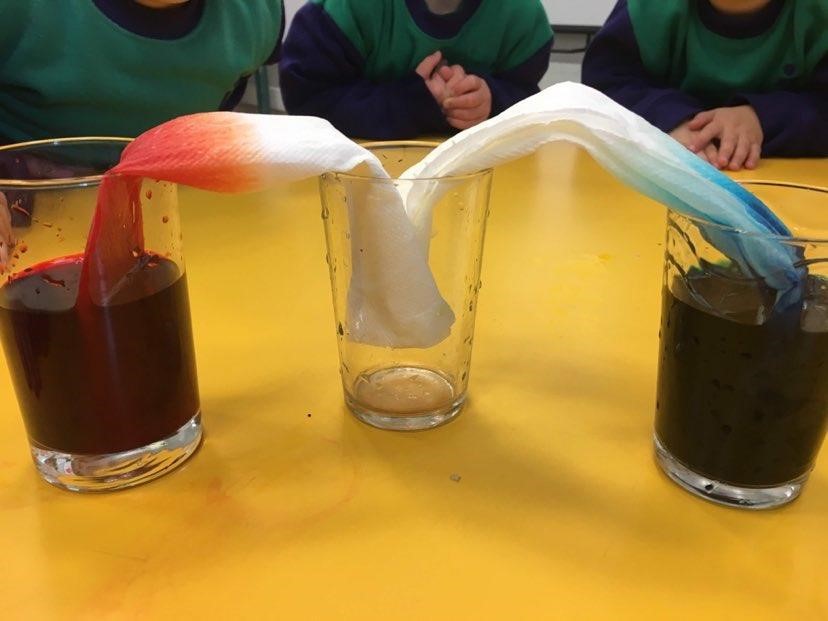
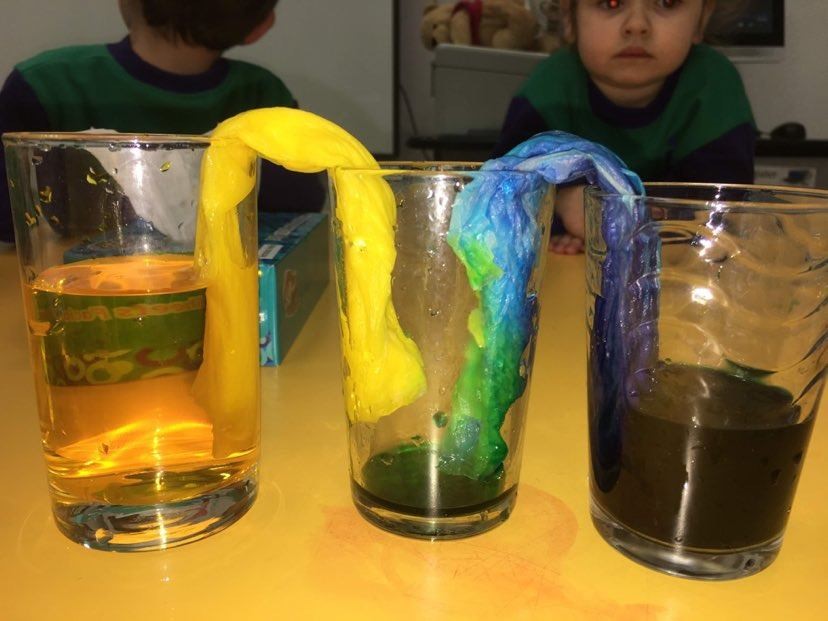
The walking water experiment is a science experiment that will introduce children to colour mixing.  From this experiment the children will learn what happens when you mix primary colours together. They will be amazed watching how the water, absorbed by the kitchen paper towels, travels to the empty cup, and fills it with coloured water.


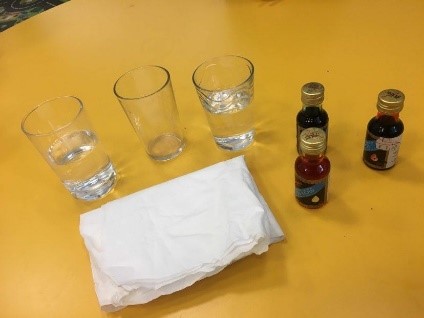
For this experiment you will need:

  • 3 transparent glass cups (It is important that the cups are of the same height)
  • Food colouring (red, blue, and yellow)
  • Some pieces of kitchen paper towels / kitchen roll
  • Water


How to do this experiment:

  1. Put the 3 cups of the same height next to each other.
  2. Encourage your child to fill the cups with water (they should be about 3 quarters full), leaving the cup in the middle empty.
  3. Choose two colours of food colouring and add some drops to the water. You can mix :red + blue, yellow + red. yellow + blue,
  4. Before adding the kitchen towel to the cups say the colours.
  5. Fold some paper towels vertically in half, and then fold in half again.
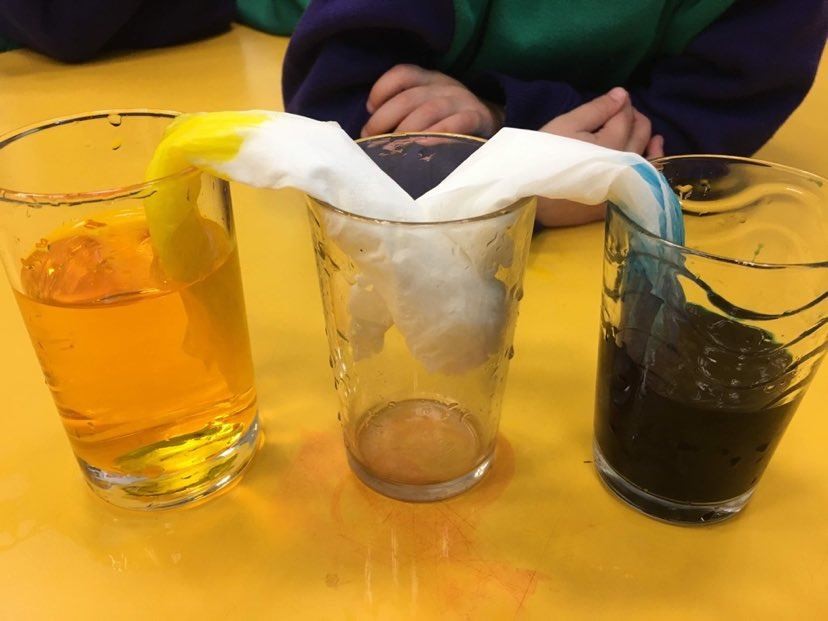
  6. Put one end of the paper towel in the water and the other end in the empty cup. (As indicated in the picture).


  1. Watch the paper towel absorbing the coloured water and filling the empty cup.
  1. At this point you can ask your child:


  • What do you think is happening?”
  • “What do you think is going to happen?”
  • “What colour do you think the water will be?”
  1. Leave some time and watch how much coloured water from the two cups has travelled to the empty cup in the middle.


Make a record sheet and record your results:

  1.    yellow + blue = __________
  2.    red + blue     = __________
  3.    yellow + red = __________


Ms Chanice

K 1.11


More from our Nurture Class (English version)

Dear parents and guardians,

We hope that you are doing fine.

Today we are sending some resources that your children can do at home.  Each activity has the recommended age group and guidelines as to how to go about it.

Thank you for your attention.

Regards,

Ms Janice & Ms Claire

Nurture Team


Indoor Game

https://www.youtube.com/watch?v=6xwiTa_xVlM

  • Recommended for all ages.
  • IMPORTANT: Watch video with your children (especially the younger ones)


Worries Story

https://www.youtube.com/watch?v=0zpH3f1TMzM

  • Recommended for younger students and parents.
  • Discuss with your children situations when your children become worried. How and what can they do to stop worrying?


Feelings Guessing Game

https://www.youtube.com/watch?v=MeNY-RxDJig

  • Recommended for all ages.
  • Video can be watched at one go but can also be split into parts if it seems too much for your child.
  • Students discuss and reflect on the different emotions mentioned.


Feelings and moods activities.


Activity 1:  Feelings Matching Activity. FeelingsMatching

  • Recommended for younger students.
  • First look at the pictures and discuss.
  • Then, match picture to word.


Activity 2:  Feelings and mood – Say this Activity feeling_and_mood_say_this

  • Recommended from Year 3 upwards.


Activity 3:  Feelings and mood – I feel practice Activity feelings_and_mood_i-feel_practice

  • Recommended from Year 3 upwards.


Activity 4:  Feelings and mood – My feelings, my needs Activity feelings_and_mood_my_feelings_my_needs

  • Recommended for the older students.


Activity 5:  Conversation cards Activity conversation-game

  • Recommended for the older students.
  • Remember that having healthy conversations with the people around you strengthen the relationships that you have!