Kindergarten Activity No. 44 – Visual Memory

Visual Memory

What is visual memory?

Visual memory focuses on the child’s ability to recall visual information which s/he has seen. It contributes to the development of pre-reading and pre-writing skills, since, to be able to read or write a child has to recall the formation of the letters and their sequential order.

There are various visual memory activities that contribute to the development of visual memory skills. These include:

  • identifying the link between similar items
  • remembering items in pairs
  • recalling the position of an item in a picture
  • recalling numbers, shapes and patterns in a serial order


How many objects can you remember?

This activity will help boost children’s visual memory skills and concentration. The aim of this activity is to look at a number of objects for a few seconds, hide them and then try to remember as many objects as possible.

Resources:

  • a print-out of the handout found here: visual memory
  • or any other pictures (you can find these from magazines)

Activity:

  • Show your child the handout with the pictures and let him/her observe them for a few seconds.
  • Hide the pictures and encourage your child to remember as many objects as possible.
  • Record the number of objects your child remembers.
  • Repeat the activity and check how many items your child can remember each time.


Some children might find it difficult to recall a number of objects at once; start with a few objects and gradually add more, so that the child is not overwhelmed.

Ms Chanice

K 1.11
Kindergarten Activity No. 43 – Auditory Memory

Auditory Memory

What is auditory memory?

Auditory memory is an important skill for coping and succeeding in life. It involves the skill of being able to remember what you hear and recall it later. Auditory memory also plays an important part in the development of auditory perception. This is the process that allows the brain to interpret what is being heard.

Children with poor auditory skills find it difficult to follow what is going on in class, to follow instructions and have problems with reading and writing. For a child to be able to understand what s/he hears and to follow directions and instructions, auditory memory needs to be developed.

Auditory Memory Games

Here are some auditory memory activities to play with your child. During these activities, your child will be asked to follow a set of instructions and record them on a worksheet. You can make the activities more challenging by adding more than one instruction at a time, according to your child’s ability.

I have prepared some handouts for you. These include an instruction sheet and a worksheet. I have also included a sample sheet (an example) of what your child has to do.

You can use these handouts or else you can make your own. Try to involve your child by encouraging him/her to draw and colour the shapes or pictures him/herself. You can also find pictures from magazines.

How to play this game:

For this activity you need to print the  instruction sheets and worksheets you can find at the end of this post.

1. Keep the instruction sheet yourself and give the worksheet to your child.

2. Make sure that your child is listening attentively.

3. Read out the instructions on the instruction sheet to your child and make sure your child understands what s/he has to do.

auditory activity level 1 shapes

auditory activity level 2 pictures

auditory activity level 2 shapes

auditory activity level 3 map activity

Ms Maria

Kindergarten Activity No. 42

L-għan ta’ dawn l-attivitajiet huwa li t-tfal isaħħu s-smigħ b’mod orali u jagħrfu d-differenza bejn il-kliem. Se jgħinuhom ukoll biex isaħħu l-vokabularju, kif ukoll il-memorja

.

Dawn il-kliem huma l-istess jew differenti?

  1. Ibda din l-attività billi tiddiskuti mat-tfal xi jfissru dawn il-kliem: l-istess u differenti.
  2. Meta t-tfal ikunu qabdu l-kunċett u qed jifmhu dawn il-kliem, spjega lit-tfal li se tkun qed tgħidilhom żewġ kelmiet u jridu jagħrfu jekk humiex l-istess jew differenti.
  3. Waqt din l-attività insisti fuq l-importanza tas-smigħ. Għid lit-tfal: “Iftħu widnejkom biex tisimgħu sew.”
  4. Jekk ikun hemm il-bżonn, irrepeti dawn il-kliem aktar minn darba.
  5. Kif it-tfal jisimgħu ż-żewġ kelmiet, staqsiehom jekk il-kliem li għadhom kemm semgħu, humiex l-istess jew differenti.

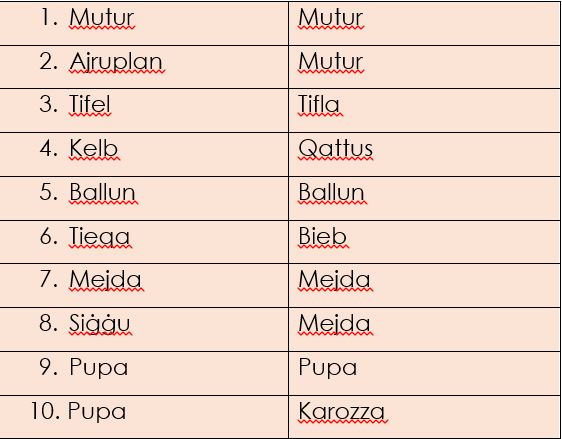
Eż.: Għid il-kliem : “mutur –    mutur”

     Staqsi: “L-istess?”

     It-tfal suppost iwieġbu: “Iva”

    Għid il-kliem : “mutur –    ajruplan”

     Staqsi: “L-istess?”

    It-tfal suppost iwieġbu: “Le”

Dawn huma eżempji ta’ kliem li jistgħu jintużaw.

Liema kelma hi differenti?

  1. Din id-darba, it-tfal se jisimgħu tliet kelmiet u jridu jagħrfu liema kelma hi differenti.
  2. Erġa’ insisti fuq l-importanza tas-smigħ waqt din l-attività.

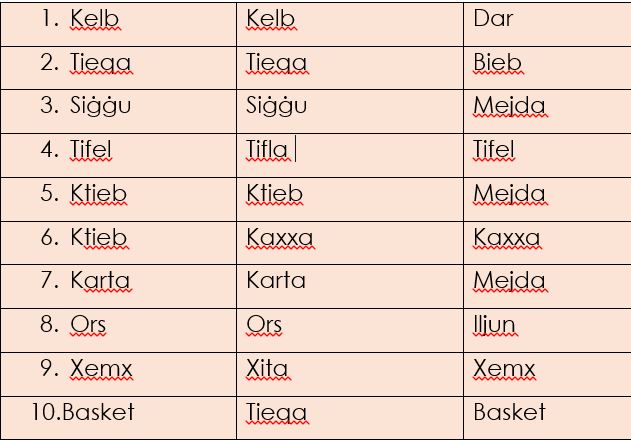
Eż. Għid il-kliem : “kelb – kelb – dar”

     Staqsi: “Liema kelma hi differenti?”

    It-tfal suppost iwieġbu: “dar”

   Għid il-kliem : “tieqa – tieqa – bieb”

   Staqsi: “Liema kelma hi differenti?”

   It-tfal suppost iwieġbu: “bieb”


Dawn huma xi kliem li jistgħu jintużaw.

Ms Rodianne

K2.1