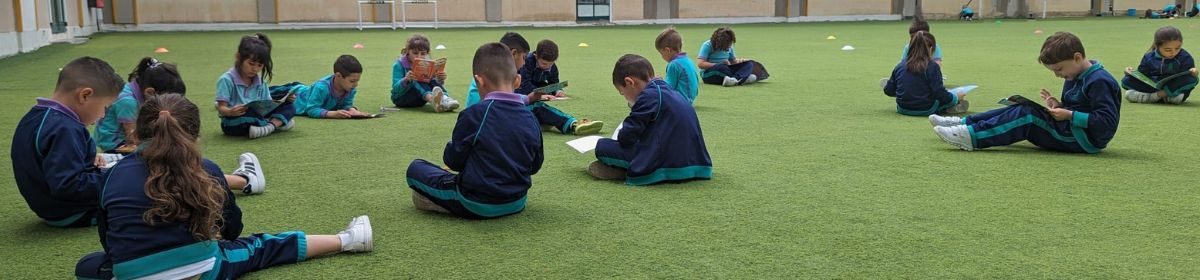
It is time for some water play!
Children love water play. Apart from being fun, children find water play very calming. Besides, water play helps children develop their fine motor skills and enhance their hand and eye coordination through various activities such as pouring, stirring, and squeezing. Water play builds the foundation for understanding various Mathematical and Science concepts. It teaches children terms such as: half, full, less, and empty.
While doing these activities have discussions with your child. This enhances their social skills as well as their language skills. Use words such as basin, funnel, bucket, spoon, colander etc.
While doing the activities, stop and ask questions to your child since this will help them develop their thinking skills and problem-solving skills.
Filling containers with water
For these activities you will need:
- Plastic water basin (or any other container)
- Funnels
- colanders
- plastic bottles
- cups
- spoons
- bottle caps
- jumbo pipets
- small watering can
- small bucket
- sponge
- water wheel
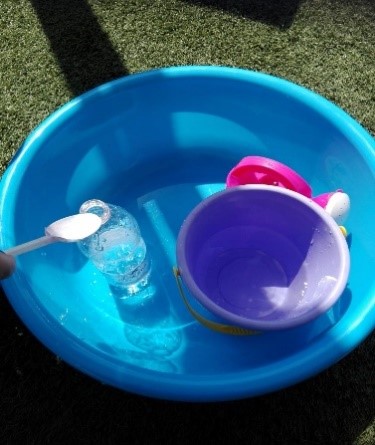
Activity 1: Filling a container with water
- Take a bucket and a container.
- Tell your child that you are going to use the bucket to fill the container with water.
- Before starting, encourage your child to estimate (guess) how many buckets of water does s/he think s/he needs to fill the container with water.
- While filling the container, count how many buckets s/he used.
Activity 2: Filling various containers with water
During this activity, your child has to transfer water from a container to another using different objects. For example, transfer water from a bottle to a watering can, or filling a bottle using a funnel.
During the activity ask your child questions like:
- “Do you think that all the water in the bottle can go in the watering can?”
- “Can you fill a cup using a spoon? Will it take longer if you fill it by squeezing the sponge?”
- “Can you fill the bottle using caps? Will it be easier using the funnel?”
While doing this activity use mathematical vocabulary such as full, empty, half full, half empty, big, small, shallow, deep, more, less, many and few.
Float or Sink
Activity 3: Which objects float, and which objects sink?
For this activity you will need:
- A metal spoon
- A wooden spoon
- A plastic spoon
- Cloth/towel
- Plastic toys
- A sponge
- A cork cap
- A lollipop stick
- A wooden ruler
- A pebble
- A small ball
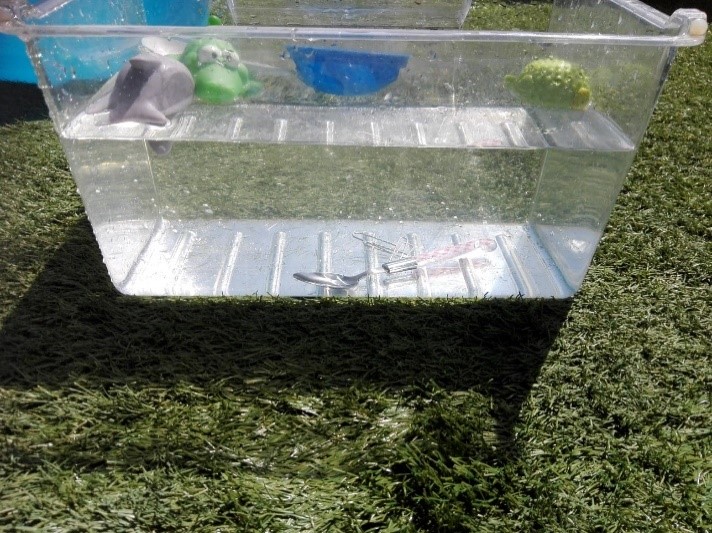
- Start by explaining what the words float and sink
- Fill a container with water.
- Get all the objects you are going to use.
- Encourage your child to say the name of the objects one by one.
- Start the experiment by making predictions. Before throwing an object in the water ask your child if they think the object will float or sink.
- Throw one object at a time.
- Talk about why they think some objects sink and others float.
- Give them time to explore with different items.
- Discuss the weight, size, and material the object is made of and how this influences the floating ability.
During this activity encourage your child to use the following vocabulary: soft, hard, wet, dry, heavy, and light. For example: “The cork cap is light, but the pebble is heavy”.
Watch the following float or sink videos:
https://www.youtube.com/watch?v=hCoDPhkE1Qc
https://www.youtube.com/watch?v=c8kszaZGLKE
Ms Pauline Kinder1.3
 St Ignatius College, Patri Ġużè Delia, Siġġiewi Primary